The New Choir Division
The original plan for the restoration had been for an organ of two manuals only, Great and Swell, which implied the provision of a new console. Late in 2021 it was decided to install a new, small Choir division as part of Phase 2, which would be very useful for service accompaniment, especially while the Swell division is being redeveloped, which would take several months. This meant that the existing console with its three manuals could be retained, for Great, Swell and Choir.
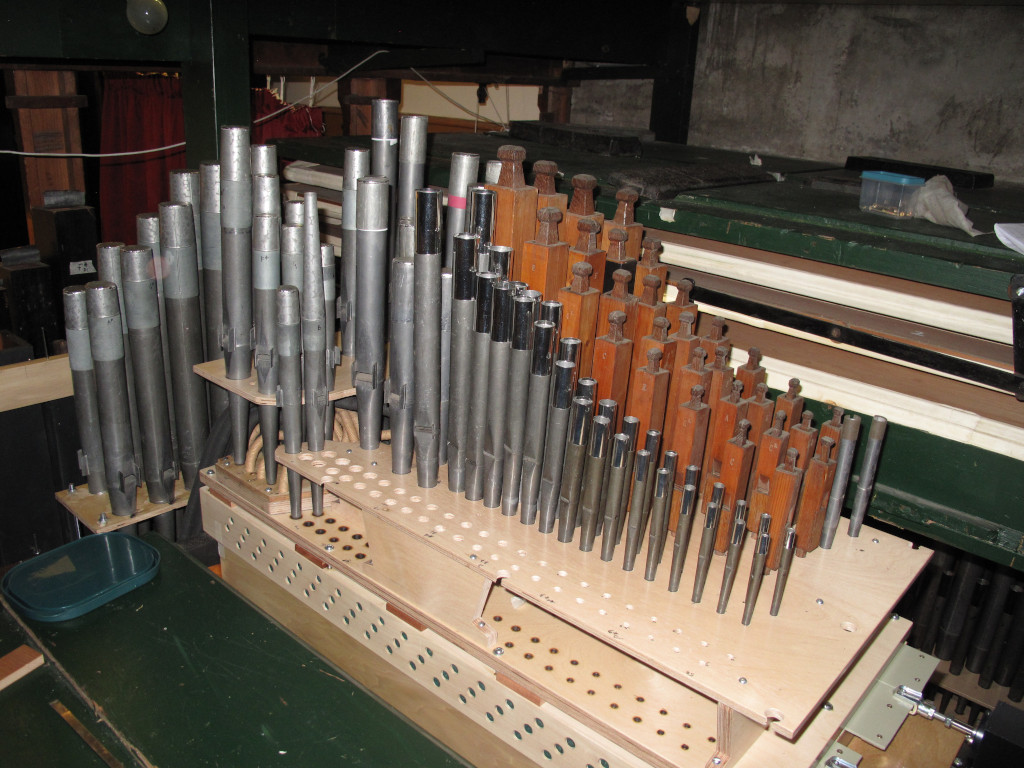
The new Choir division uses tracker action, and consists of three ranks:
Stopped Diapason 8
Koppel Flute 4
Flageolet 2
In this image the Choir drawstop knobs (top) are temporary, and will be replaced with new ones to match the Pedal drawstops.
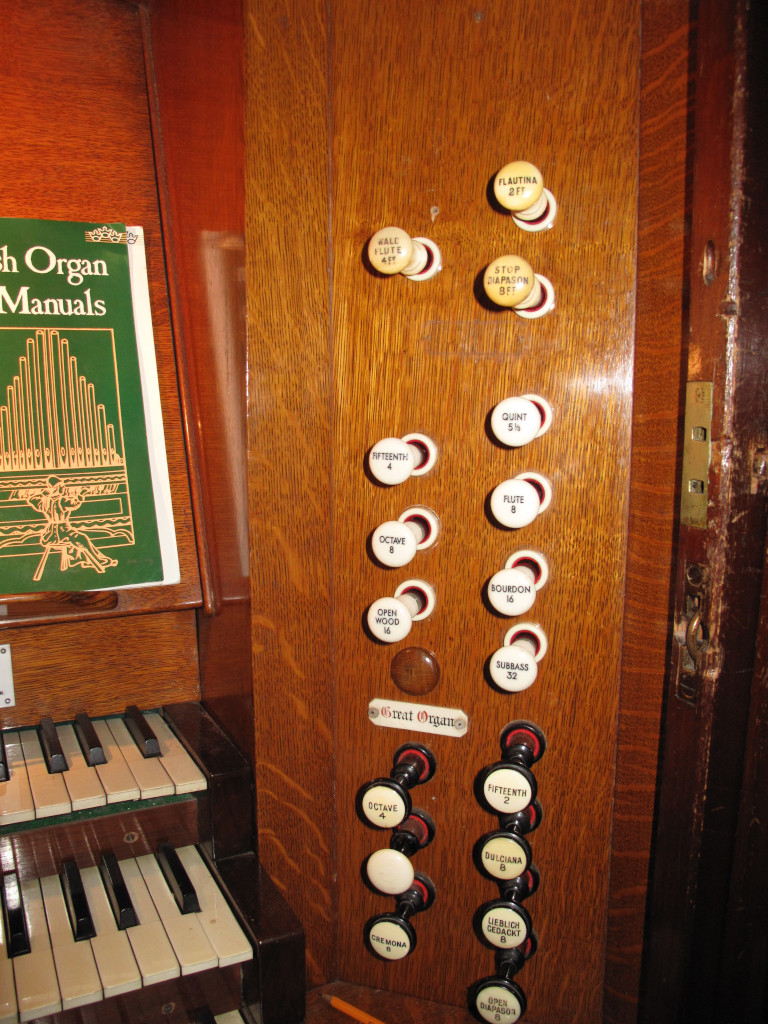
The new Choir division was first used on Sunday 8th May 2022.
The Swell Division
After the new Choir division had been installed, things went quiet as far as the church was concerned. By February 2022 Trevor had started on the design of the Swell soundboards. These would be constructed by David Maybury, as the soundboards for the Choir had been.
During 2022 the old Swell pipes and soundboards were removed. Of the existing pipes, some ranks would be rescaled, revoiced, and reused to form part of a revised stoplist. This would be done in Trevor’s workshop.
Because the new Swell division was to be considerably larger, eleven ranks instead of seven, it needed a larger swellbox; some of the original stops omitted the lowest octave, which would be restored, adding twelve large pipes to each of those ranks, again requiring more space, including vertically; finally, the space inside the organ from side to side (as seen from the organist’s position) was not wide enough to accomodate a full rank from bass to treble without compromising maintenance access to other parts of the organ.
Trevor’s ingenious solution to these problems was to design the new Swell division in two sections, one behind the other, with two soundboards. The front section contains all but the lowest eighteen notes of each rank, which are accomodated in the rear section. The swellbox itself uses most of the original box and its shutters; above and behind that there are two more shutters on the front of the taller rear section of the box. A picture paints a thousand words here!
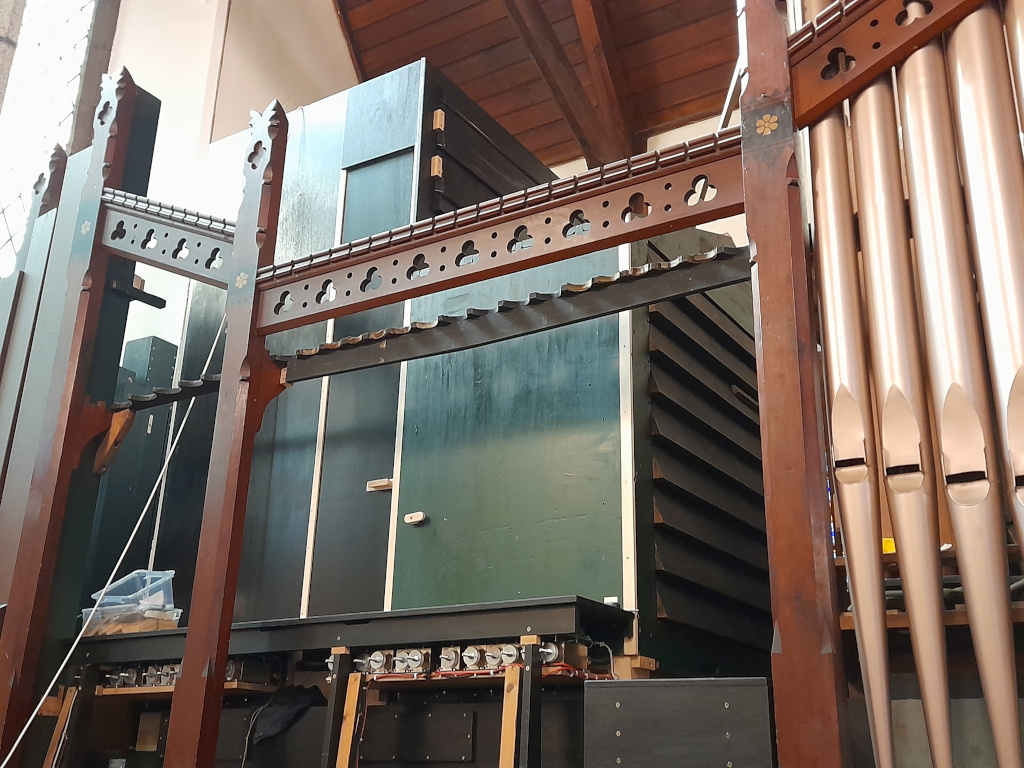
I am grateful to Adam for taking the next three photographs, from inside the swellbox.
This image shows the two shutters of rear section of the swellbox from inside. Through the gap below them is the the front portion of the swellbox, which retains its pitched roof, so to speak.
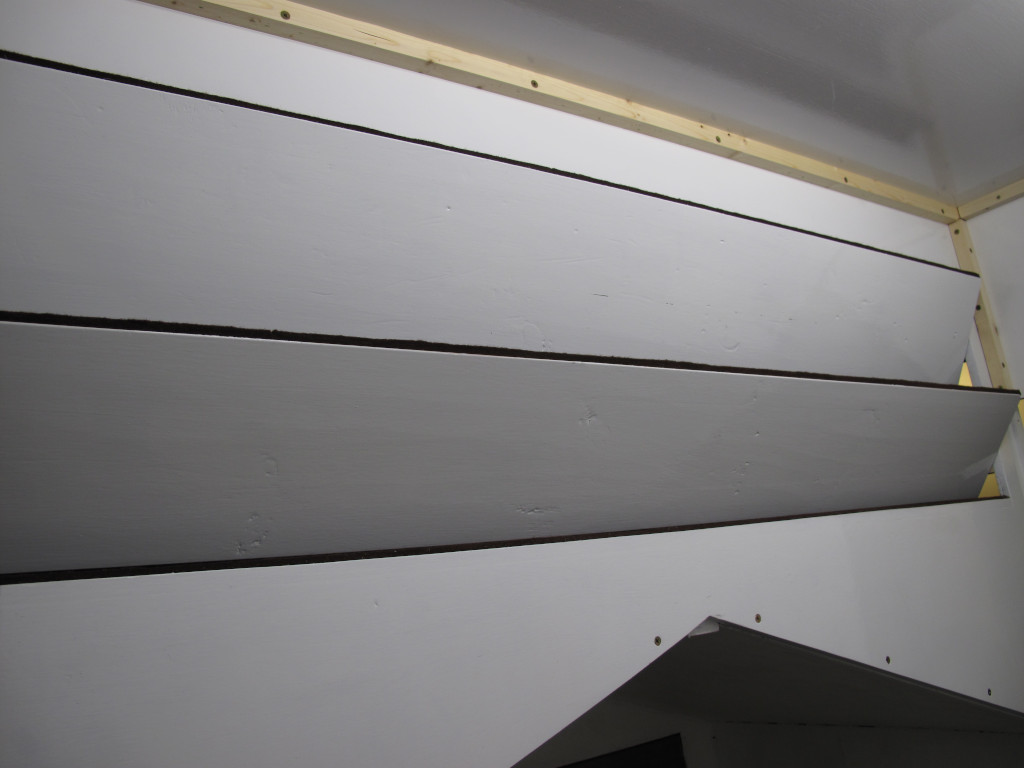
The new swellbox and the soundboards were installed about the end of March 2023.
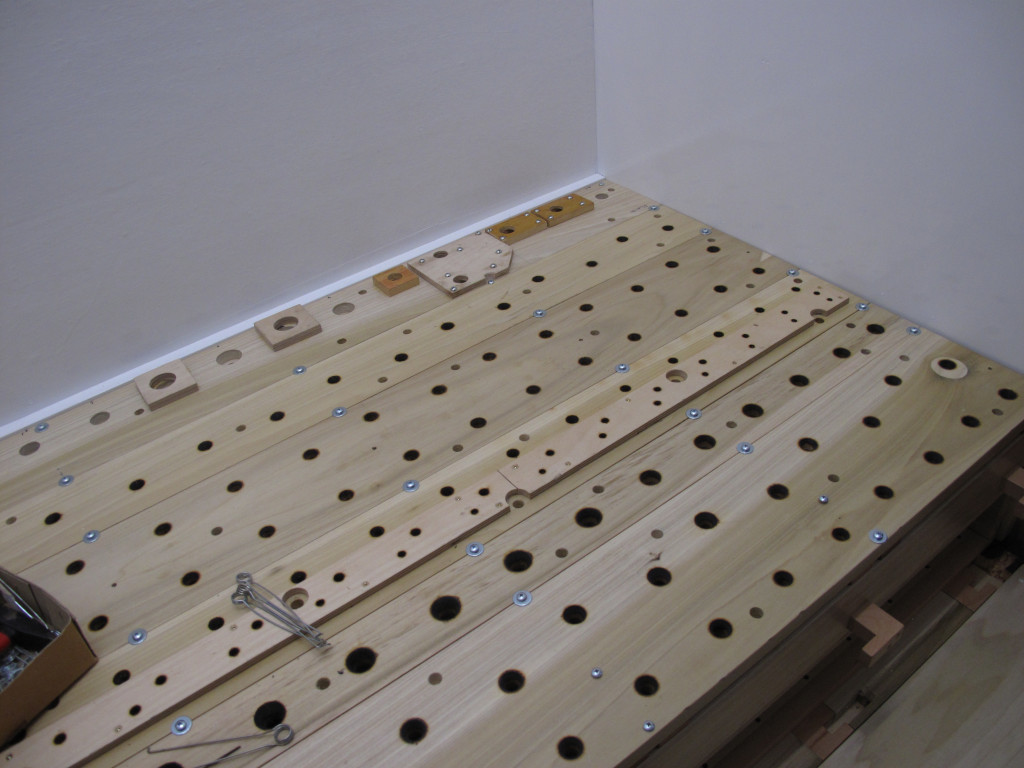
This image shows part of one of Swell soundboards, under construction.
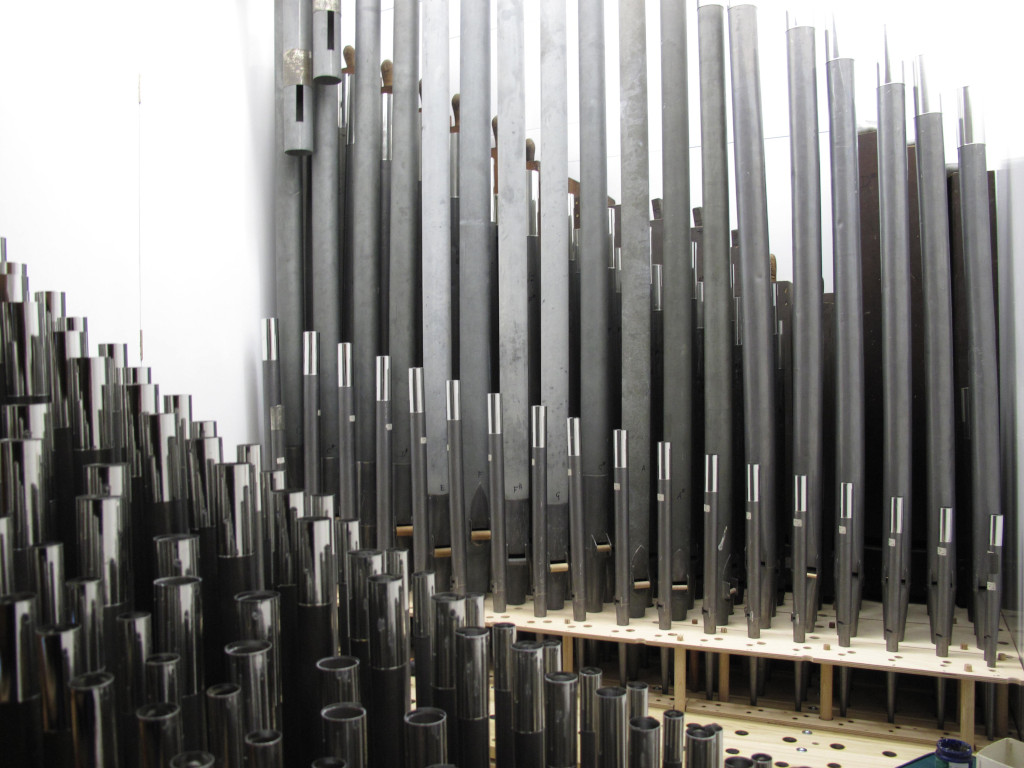
This image shows some of the Swell pipework.
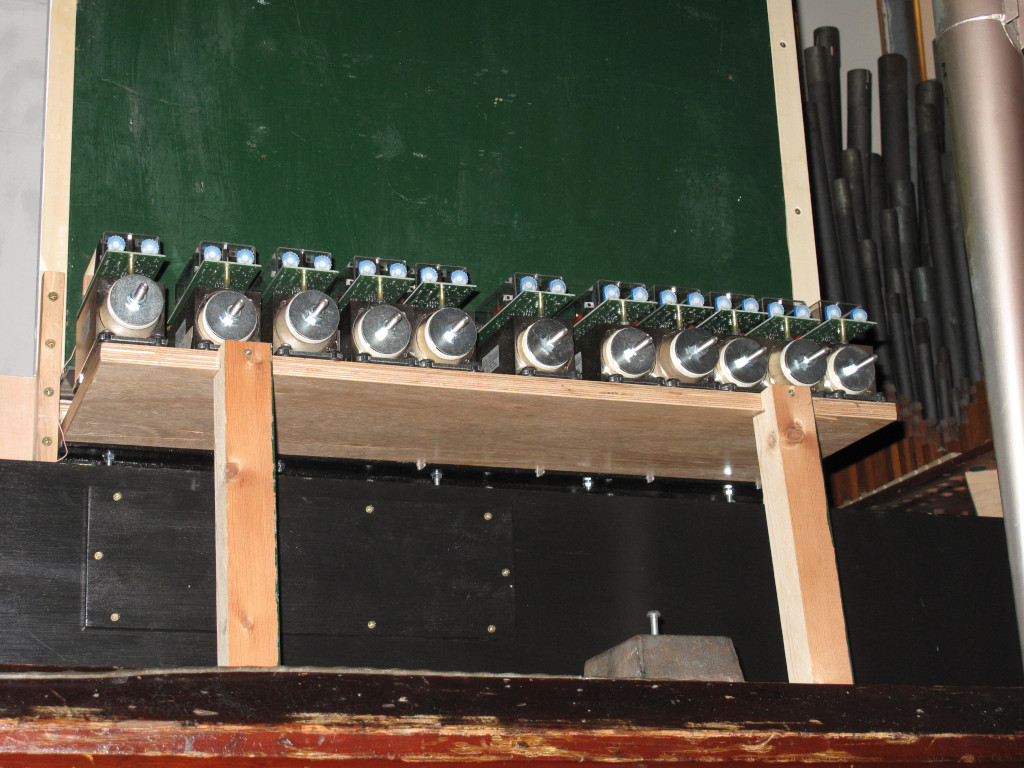
This image shows the slider motors of the front portion of the swellbox. When the organist selects a drawstop, the corresponding slider motor is activated which allows the selected rank of pipes to speak.
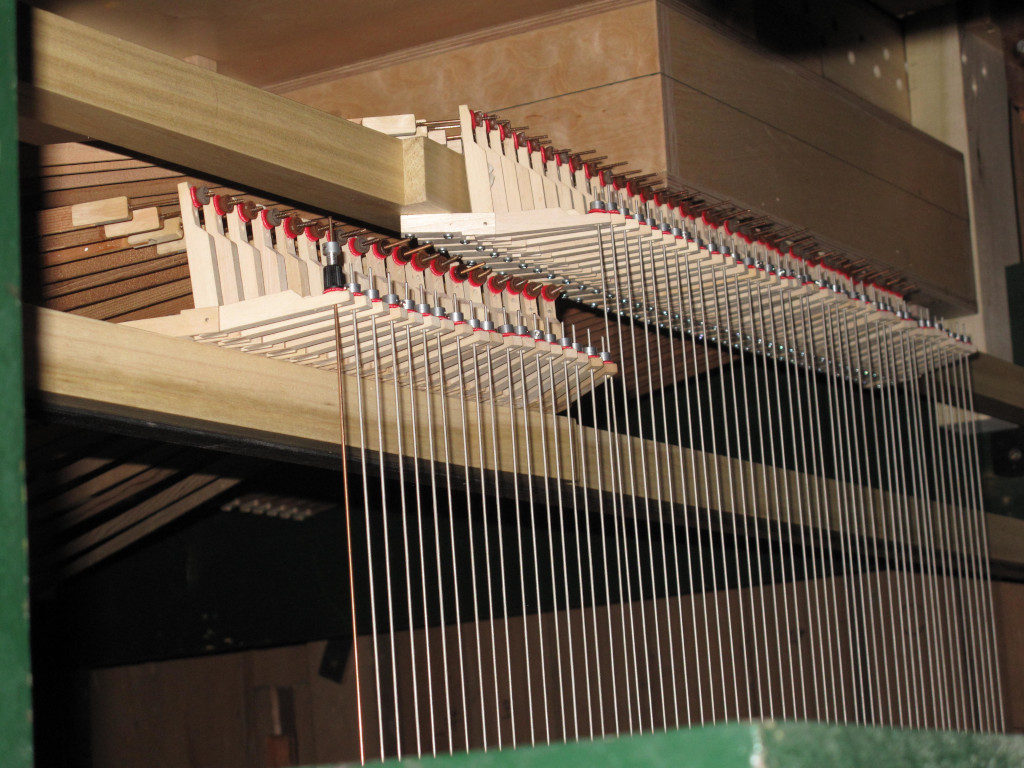
This image shows part of the Swell tracker action. It is divided into two sections: the one on the left serves the lower eighteen notes of the Swell manual, directing the action to the rear section of the swellbox which contains the larger lower-sounding pipes, and the one on the right directs the action to the front section of the swellbox and the smaller higher-sounding pipes.
On Sunday 16th April 2023 the new Swell division was heard for the first time, or at least part of it; the first six stops had been installed. The 2′ Fifteenth was available the following Sunday, and the Mixture the Sunday after that. In June the 16′ Basset Horn was installed, and with the arrival of the 8′ Trumpet and 8′ Oboe at the beginning of July the Swell division was complete.
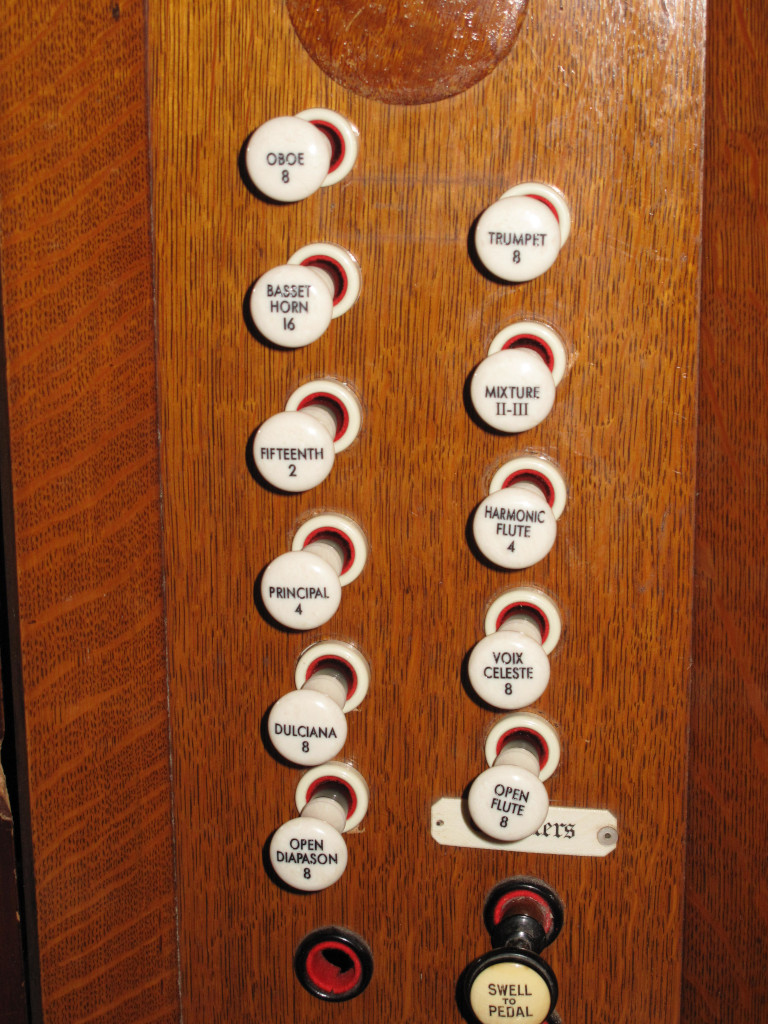
The full stoplist is
Open Diapason 8
Open Flute 8
Dulciana 8
Voix Celeste 8
Principal 4
Harmonic Flute 4
Fifteenth 2
Mixture II-III
Basset Horn 16
Trumpet 8
Oboe 8
In March 2024 the organ, although not yet fully restored, made its first public appearance apart from church services: a short recital of music by J S Bach, played by David O’Shea.
This was part of the Pipeworks Education & Outreach programme, where they offered to parishes these recitals, designed for audiences not used to attending organ recitals, in the week of J S Bach’s birthday. Pipeworks, the Dublin international choral and organ festival, is Ireland’s premier advocate organisation for the pipe organ, and David is their Education & Outreach Officer.
There was no charge to us, and we were free to use the recital as a fundraiser for our organ restoration.
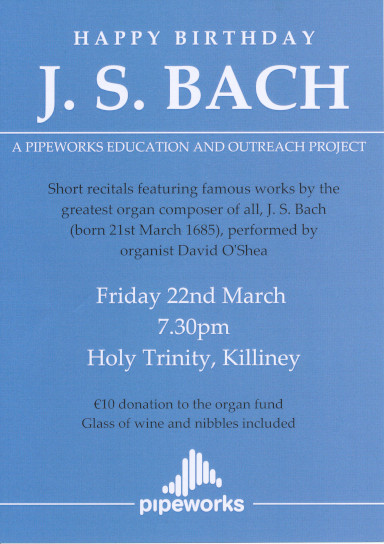
The event was a great success. It had been well advertised in the locality with 90-plus attending. Afterwards many lingered to chat with our guest organist and each other over a convivial glass of wine and some tasty bites.
From small beginnings such as this it is hoped similar events, which are attractive to a wider public, can be organised in the future, marking the church not only as a place of worship but also as a suitable and attractive location for cultural and social activities.
 Holy Trinity Parish Killiney